43. Career Transitions: Sofia Oliveira on what 140 job applications taught her about life after academia
Subscribe to the Amplifying Research podcast:
Apple Podcasts | Spotify | Overcast | Pocketcasts
Episode show notes
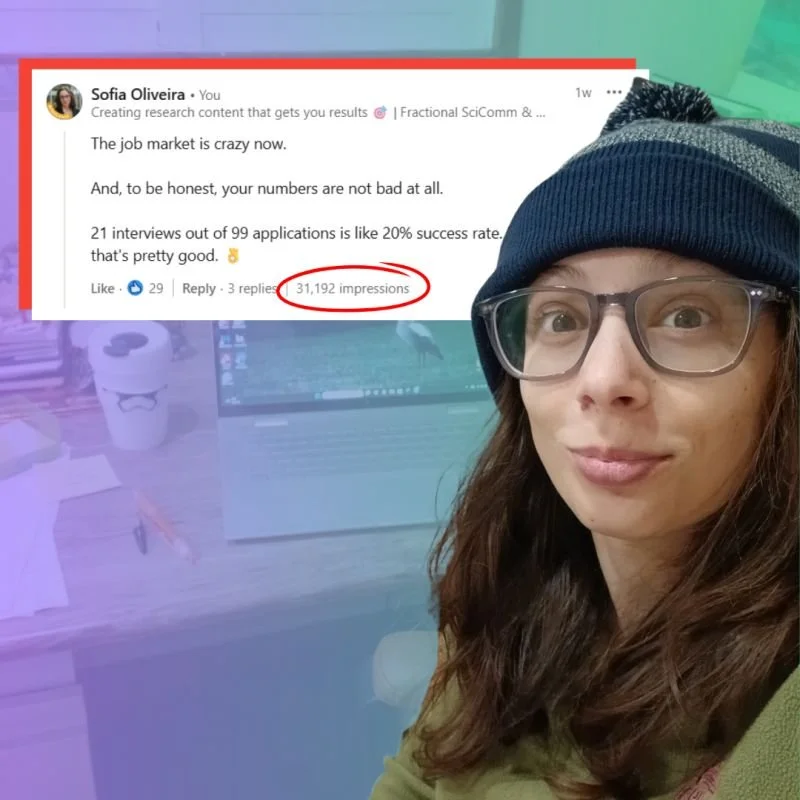
What if leaving academia isn't failure – but the path to work that actually fulfils you? Sofia Oliveira finished her PhD, spent six months applying for 140 jobs, and discovered a career in science communication that she finds more rewarding than anything she experienced in the lab. She joins us to share the real numbers behind her transition, the mindset shifts that made it possible, and how LinkedIn became her secret weapon for finding opportunities.
Sofia is a science communication and marketing specialist focusing on life sciences, biotech startups, and nonprofits. After completing her PhD in 2021 and working as a project manager at university, she made the leap to industry in 2023 – tracking every application, interview, and offer along the way. Today she's a freelancer with over 10,000 LinkedIn followers, where she regularly shares remote job opportunities to help other researchers explore their options.
"To be honest, I am much happier now than when I was back at academia, and I think that's all about it. You know, you want your career to be fulfilling and that looks different for different people. But for me, what I'm doing now, it's fulfilling." – Sofia Oliveira
Whether you're a PhD student wondering what comes next, an early-career researcher eyeing the grim odds of landing a professorship, or simply curious about what else is out there, this episode offers honest data, practical strategies, and a refreshing perspective on career exploration.
If you enjoy this episode and want to go deeper, check out Sofia’s Career Hub on Patreon – featuring the actual CVs she used to land interviews, live Q&A sessions, and group mentoring.
Our conversation covers:
The stigma around leaving academia – and how to move past it
Sofia's job hunting data: 140 applications, 11% interview rate, 8 offers
How academic success rates (grants, professorships) compare to industry job hunting
Types of roles researchers can transition into: science communication, technical writing, project management, consulting, and more
How to identify and articulate your transferable skills
The case for applying while you're still employed
Freelance vs part-time vs full-time: finding the model that suits you
Building a LinkedIn presence that attracts opportunities (in just 2-3 hours per week)
Why treating your career like an experiment might be the most scientific approach
Find Sofia online:
LinkedIn — https://www.linkedin.com/in/oliveira-ss
Sofia’s Career Hub on Patreon — https://patreon.com/Oliveira_ss



Practical tips:
Start exploring while you're still employed:
If you have some stability, use it. Applying for jobs while still employed reduces desperation and gives you the power to wait for the right opportunity.
"Don't leave your job yet. Just start, you know, just start seeing how it feels like, start applying... And then it gets less scary because you are trying to get something better, but you still have your usual job." – Sofia Oliveira
"You will not feel as much pressure to accept the first offer that comes along. You know, you have time to really wait for the one that suits you better." – Sofia Oliveira
Audit your transferable skills:
You do far more than lab work. Write down all the tasks you perform – grant writing, project management, mentoring, science communication – and use this list to identify where your skills might apply.
"Start writing down all the tasks you do, what you do during your PhD, during your research... You are not full time in the lab doing experiments, right? You were writing research grants. You were writing reports, maybe you were even managing European projects... All of that is experience that gives you skills that you can then use in the industry." – Sofia Oliveira
Research the job market like a literature review:
Treat your job search with the same rigour you'd apply to academic research. Study job postings, understand what roles exist, and match your skills to requirements.
"That's a bit like, you know, doing your literature research, but instead of going to the scientific databases, you need to go to the job market. So you need to keep up with the jobs that are being published, checking out what tasks those jobs will imply, what are the skills required." – Sofia Oliveira
Understand the real odds:
Job hunting takes time and involves rejection – but the numbers may be better than you think. Sofia applied for 140 jobs over six months, achieved an 11% interview rate, and landed 8 offers. Compare this to academic grant success rates (often around 3%) or the odds of landing a professorship.
"If you look at the success rate for getting a professor position, you get way more scary than the numbers I gave you." – Sofia Oliveira
Consider different work models:
It's not just full-time employment or nothing. Freelance, part-time, or hybrid arrangements can offer flexibility, diversity, and stability in different combinations.
"I didn't decide to become a freelancer. Life made me a freelancer, and I've enjoyed it very much because I can do so many different things... I love the diversity and the flexibility that comes with it."– Sofia Oliveira
Build your LinkedIn presence (it takes less time than you think):
Sofia dedicates around 2-3 hours per week to LinkedIn – posting valuable content, commenting on others' posts, and responding to DMs. This has led to inbound job offers and over 10,000 followers.
"Maybe three hours per week I spend on LinkedIn. And this includes doing content – I publish three times per week – comments, DMs." – Sofia Oliveira
"Even if you dedicate one hour per week and you post once, just once, just one post per week and the rest of the hour you have free to comment on other people... the comments get you a lot of visibility." – Sofia Oliveira
Focus on providing value, not self-promotion:
The key to LinkedIn success isn't marketing yourself – it's giving your audience something useful. When you focus on value, visibility and opportunities follow naturally.
"If you are going on LinkedIn and your sole goal is to market yourself, and that's what you write about, you are not going to be successful... You need to create value for the audience. So when you write something, it needs to somehow deliver value to them." – Sofia Oliveira
"What is the advantage for me as a professional to share jobs that other people can apply? How does that market myself? You know, maybe that's not the best content to market myself, but it's something I'm passionate about and it's something that brings value to my community." – Sofia Oliveira
Treat your career like an experiment:
You don't need to have it all figured out. Try things, see what's fulfilling, and adjust. The same scientific mindset you apply in research can guide your career exploration.
"For me, it's much more about trial and error, you see... I didn't know I wanted to be a freelancer... It's much more like improvisation almost, you know, let's go with the flow." – Sofia Oliveira
"You should always keep an eye on the job market. See what's the trend of skills, what jobs are in demand. Have like a plan B or an exit strategy if you need one." – Sofia Oliveira
Credits:
Host & Producer: Chris Pahlow
Edited by: Laura Carolina Corrigan
Music by: La Boucle and Blue Steel, courtesy of Epidemic Sound
- Public engagement
- Career development
- Knowledge mobilisation
- Team alignment
- Stakeholder/audience mapping
- Storytelling
- Leadership
- Strategic comms
- Community engagement
- Collaborating with professional staff
- Talks and presentations
- Making your work relatable
- Co-design
- Communicating in different formats/mediums
- Interdisciplinary collaboration
- Strategy
- Impact planning
- Behaviour change
- Your pitch
- Networking